
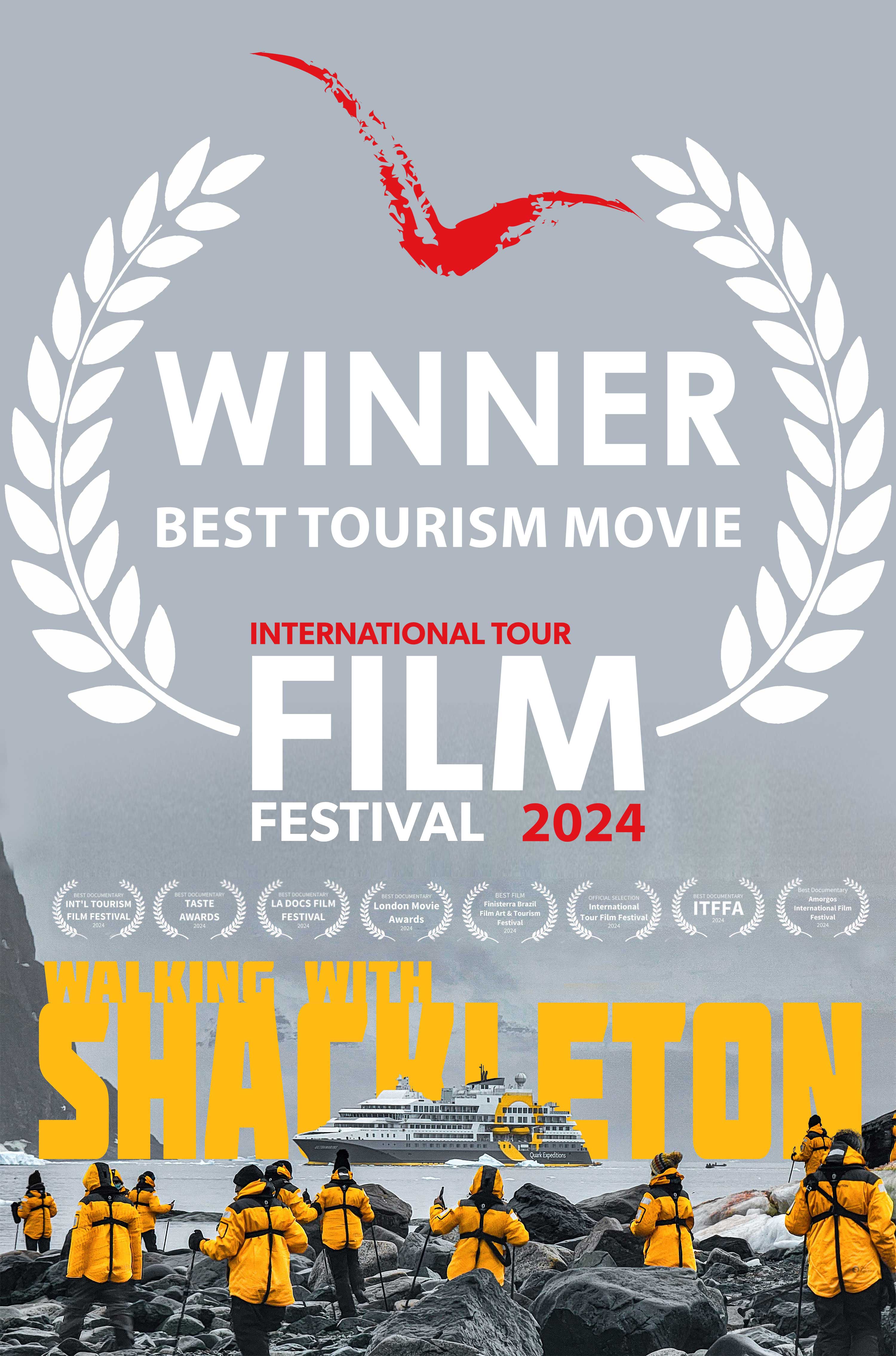
A very big day for “Walking with Shackleton” as it wins the premio first prize of Best Travel Film at the International Tour Film Festival in Rome this year. A tremendous honor indeed as our film played at this star studded cultural event and delighted judges and audiences alike.
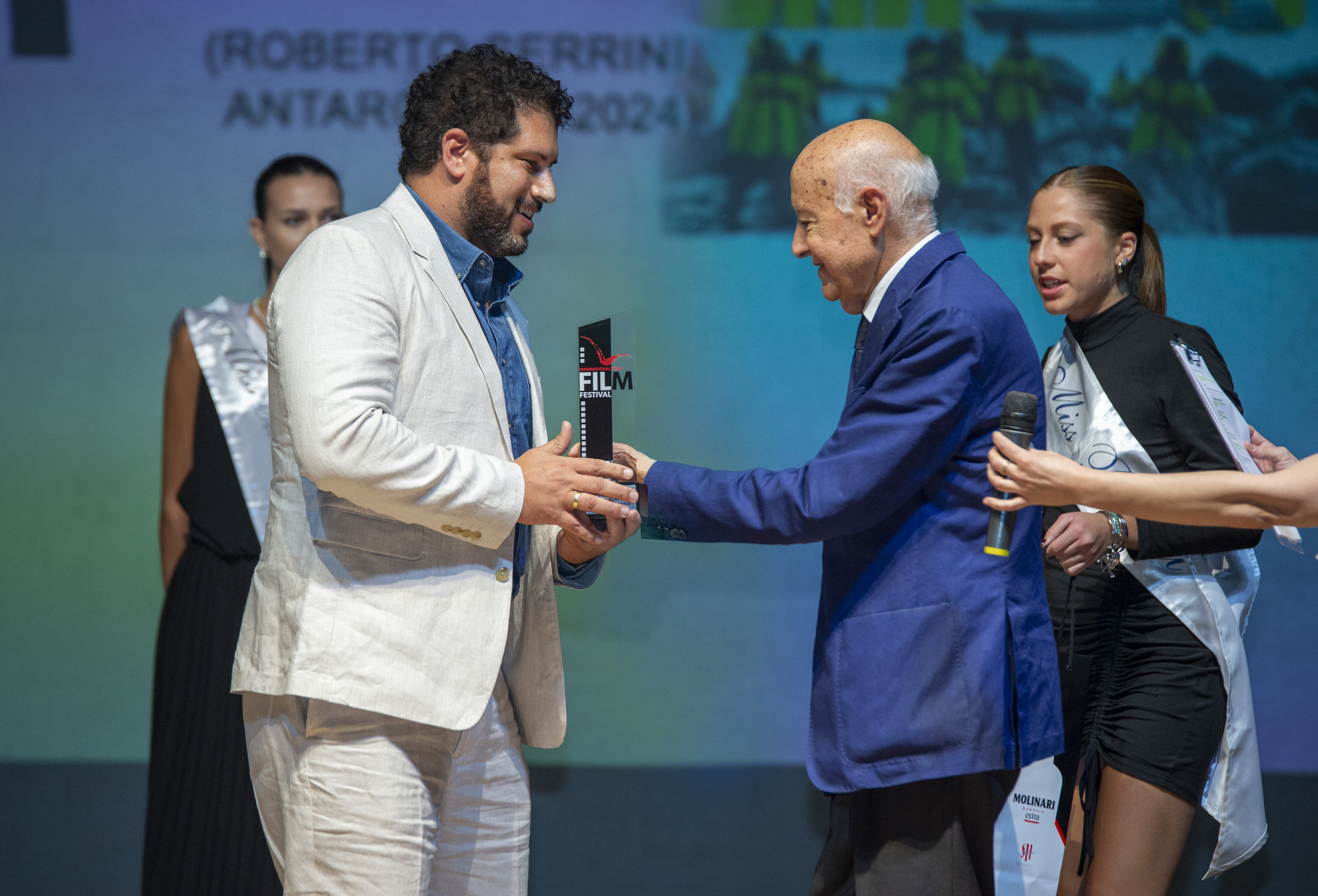
“The film was conceived while on an expedition to Antarctica with Quark for Get Lost Magazine which Roberto Serrini, the director, is an Editor at Large for,” states Justin Jamieson, Owner and Editor in Chief of Get Lost Magazine. “I was amazed at the depth and profundity of this film, and that one person could have put it together. It feels like an full scale Nat-Geo piece, not a solo journalist on assignment.”
“The film as intricate as it is was actually conceived in the sauna of the ship. The Ultramarine is perhaps one of the most advanced and luxurious vessels on the sea. The sauna has floor to ceiling windows that put you in these remarkably remote destinations but in extreme comfort.” states the director, Roberto Serrini. “I was in there reading Ernest Shackleton’s journal and all he kept talking about was how cold and uncomfortable it was as drops of sweat from my brow kept hitting the page. I was looking at the immense beauty and wonder he discovered but without any of the discomfort or danger. It was an amazingly powerful amount of perspective of how far we’ve all come as travelers.”
It was this unique juxtaposition that lead to the concept of the film, one that is a departure from the dozens Serrini has produced over the years of being a travel filmmaker and journalist. This was a conscious choice on the director’s part to combat the increasing epidemic of what he calls the “Carbonara Complex” happening around the globe.
“The world of travel is becoming more and more numb and dull unfortunately,” states Serrini, “due to the fact that everyone is producing content, and the same type of content around the world. It’s a snowball effect that I also have been part of unfortunately. One person says that “this is the best” then because people have been told that, they repeat it. There is no discovery, and it is destroying the biggest gift of traveling: to experience something new.”
The film, which has already won 9 film festivals including a prestigious Gold Magellan Award, is much more then just a travel piece on the last continent, it is an attempt at a new genre that will hopefully still inspire people to travel, but not cause a flood of tourism that destroys a destination. Places like Barcelona are prime examples of the devastating effect of over tourism and cultural bleaching due to the “carbonara complex”, which is a direct result of lazy content directing unadventurous travelers to one single destination. It is a global issue, and news of this new genre of travel film has excited many news outlets including Cinema Italiano, La Provincia, Paese Roma, and Monolite. This signals to Serrini to continue to make films that aren’t about “do this, eat that, see this” but to inspire an idea of travel that if you went in a certain direction you could have a certain type of adventure.
“I started traveling when I was 15 years old,” states Serrini, “I was the only child of two airline employees, and while we had no money I could fly for free anywhere in the world. Back then I would walk up to the gate, write in a 3 letter airport code, and get on the plane. There was no planning, no concept or premeditated idea of where I was going. Everything was a discovery for me when I arrived, and that is exactly what got me addicted, and exactly what we are loosing more and more each day.”
It wasn’t just the ease of access to get places, it was the type of experience travel afforded back in the 90’s that simply can’t be accessed easily now. With so much content out there, people have seemingly already taken the trip before they leave there home. What’s worse, they have an opinion before even experiencing the foreign culture, so there can be no possibility of gaining that intimate perspective.
“You have to try to imagine, there were no cell phones, there was no internet. So whatever knowledge you brought with you to a country is all you had while you were there. Maybe you had a ratty guidebook that was out of date the minute it was published, but that was it. So what you had to do was talk to people. They told you where the hostel was, the restaurant, where to go meet girls or guys, and what to do. It was like being able to ask the city itself what to do, which was amazing. Now we are told what to do by other foreigners, and everyone complies. If you go to Rome and don’t eat carbonara at Il Carbonara did you even go to Rome?”
The effect that the internet has had on travel I doubt anyone could have predicted. The main issue is the loss of unique culture. What happens is that as on piece of content becomes popular, millions of people see it, then go have that same experience, and make another piece of content that echos the first. Then there is a reaction from the destination since they find that tourist are only gravitating to one thing; one restaurant, one experience, one dish. If you traveled to Italy in the 90’s every restaurant had a regional specialty from North to South because that was the culture that evolved there over hundreds of years. Now every restaurant serves carbonara, even if that region has nothing to do with carbonara, and those regional dishes are forever lost. This is the “carbonara complex” that worries Serrini, where foreign cultures are forced to cater to hordes of tourists in order to compete, and it’s all fueled by the echo chamber that is influencer run social media.
“What addicted me to travel was perspective. Only after years of travel did I realize it was the differences in cultures that was fueling my desire to see the world. Leaving your familiar surroundings and going somewhere different changes your perspective on life. You start to realize that while we are all different, we’re also remarkably the same. The more congruent the culture is to your own the greater the perspective you gain. I’m from NYC. We have the slice. That’s what we eat on the street. Go to Japan and have an takoyaki. That’s a octopus ball. That’s their slice. Totally different in every way, but at the same time exactly the same. Start to make these connections with art, music, fashion, culture and you start to become what I would call enlightened. I mean Twain said it best, “travel is fatal to prejudice, bigotry, and narrow-mindedness” or at least used to be when it challenged your own ideas. How can you be challenged when your surrounded by people from your hometown in a foriegn country all eating the same meal and having the same experience.”
Serrini has seen the travel landscape change dramatically over the years. From his early days of wanting to be a travel professional and contributing to print publications using nothing more then a notepad and film camera, he now finds himself editor of a digital publication making full scale travel films for various global brands. Despite this upward evolution, he is unsure of the quality of future travel.
“I see travelers out there enjoying cities in different ways, and I know they have no concept of what travel used to be, nor does it matter, but I cant help wondering if they are missing out on the best part of leaving home. To me it was forging friendships and discovery, where every cafe, every museum, every vista was as if you discovered it. Now they all check the best place to go, how to get there, and when they arrive they are surrounded only by other people like themselves. It used to be exotic being from the United States abroad. Now it’s exotic to be from the city you are visiting, and that’s wild. The access to information is wonderful, but it has removed the possibility of getting lost, and that is where real discovery tends to happen.”
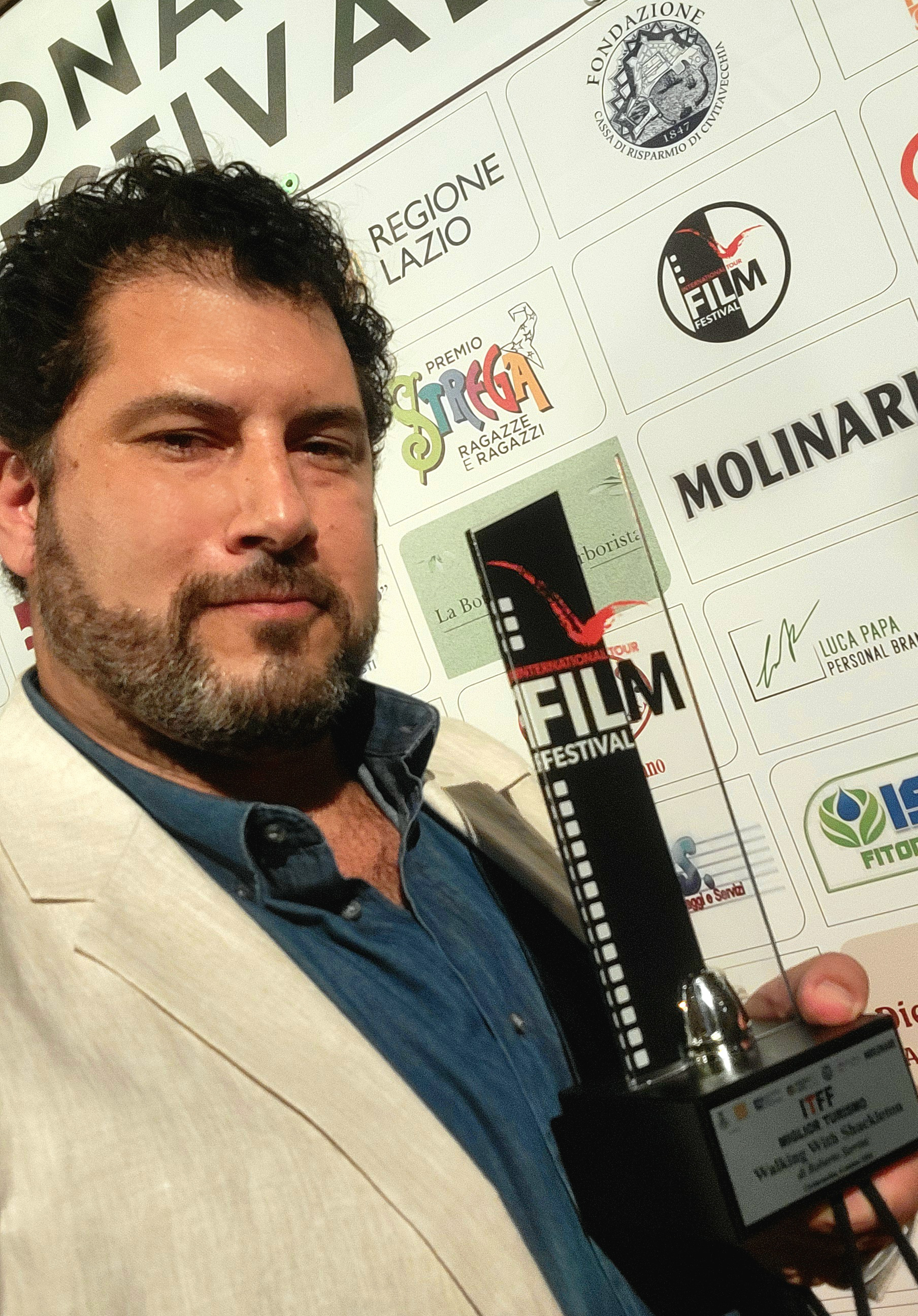
Creating new forms of content that evolves with the travel-sphere is something that Serrini believes has to happen in order to keep the allure alive. It is natural that there was an bloom of parroting content online over the last two decades, but Serrini feels those same intrepid travelers are now looking for something new and unique, and providing a new genre of content is exactly what they are hungry for.
“I’ve made countless reviews of destinations on each continent, and am no stranger to the type of content being massed produced. To me it is as lackluster as some of the destinations and any traveler is going to be looking for something a bit more profound and alluring. “Walking with Shackleton” was my first attempt at something a bit more mature and avant-garde that would inspire anyone at their core to get up and out the door and have a real adventure, or dare I say, a perspective shift. I think by elevating the type of content from these cookie-cutter templates that AI can easily reproduce, to something with a profound amount of soul and strong viewpoint, is what the next generation of travel geeks are going to seek out and demand, and hopefully the world gets a little less known again, and we can all experience getting lost at least once in our lives.”
ROBERTO SERRINI is a journalist and filmmaker who spends his time in NYC and LA when he’s not somewhere else. He is an Editor at Large for Get Lost Travel Magazine, owner of The TravelClast, and a commercial director who is love with being surprised by the world.
 The TravelClast